Using Cabinet Door Samples Before Ordering
A door sample is the cheapest test in a kitchen project: CasaBuilt lists each one at $9.99, refundable against a cabinet purchase, and keeps 16 doors in stock. Eight of those 16 are Shaker, so the most common profile is also the easiest to compare side by side. The point of ordering early is not to collect colours. It is to watch one door against your own wall and floor from morning to night, before a four-figure cabinet order locks the choice in.
Key takeaways
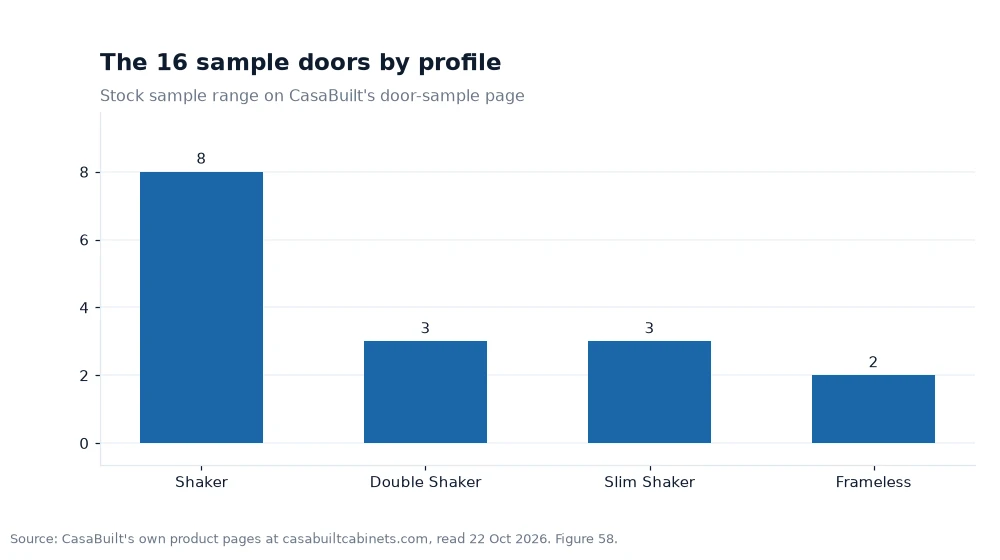
- Sixteen sample doors are listed, split across four profiles: Shaker 8, Double Shaker 3, Slim Shaker 3 and Frameless 2.
- Each sample is $9.99 and the fee is refundable with a cabinet purchase.
- Test a door upright against the wall at eye height, with a flooring offcut directly beneath it.
- Judge the door in three light conditions: indirect morning light, midday sun and evening lamp light.
Why a sample settles what a screen cannot
A photograph of a kitchen is lit for the photograph. The photographer chooses the time of day, the exposure and often a colour grade, and the screen on your desk adds a white point of its own. Two doors that look identical in a product gallery can separate sharply on a north-facing wall in January. That is not a trick of marketing. It is the normal behaviour of painted and stained surfaces under different light.
The sample removes the photograph from the decision. You get the actual door, at actual size, with the actual edge and the actual sheen. You can hold it against the wall, lay it on the floor and carry it to the window. CasaBuilt's sample page describes the fee as refundable with a cabinet purchase, which changes the economics: the $9.99 is a deposit on a decision, not a sunk cost. Order the doors you are genuinely choosing between and the money comes back when the kitchen is ordered.
Order early enough to live with the door for a few days. A choice that survives a weekend of ordinary light is a different kind of choice from one made in a five-minute showroom visit.
Build a three-light test bench
Set the door upright on the counter or against the backsplash, at the height it will hang. Do not judge it flat on a table, because a horizontal panel catches light differently from a vertical one. Put a flooring offcut directly under it, then step back to the distance you stand when you cook. This is the view the door will actually occupy, and it is the only view that matters.
Then run the same door through three light conditions. First, indirect morning light with the overheads off. Second, direct midday sun on the face of the door. Third, the warm lamp or pendant light you use after dark. Write one line on each pass: what the door does to the wall colour, and whether the floor pulls warm or cool against it. A door can pass the first test and fail the third, and the third is when most people are home. If you are comparing several profiles, order a rta cabinets sample in each profile rather than guessing from the profile names.
Keep the test bench in one place for the whole comparison. Moving the door between rooms resets the experiment and makes two samples look closer than they are.
Match the profile to the test
The profile changes what the light does before the colour gets a chance. A Shaker door has a flat centre panel inside a frame, so the frame casts a thin shadow line on the panel. A Slim Shaker narrows that frame, which leaves more flat panel and makes the door read calmer on a long run. A Double Shaker adds a second recess, and that second edge catches highlights in a way a single recess does not.
The Frameless sample is the outlier in the range. There is no face frame to break the line between doors, so the gaps between panels become the visual rhythm. On a small kitchen that can look deliberate. On a wall of mixed widths it can also look busy, which is exactly the sort of thing a sample on the real wall will show you and a rendered plan will not.
| Profile | Doors in the sample range | Share of the 16 | What the sample lets you test |
|---|---|---|---|
| Shaker | 8 | 50% | Whether a standard recess reads too traditional for the room |
| Double Shaker | 3 | 18.75% | How a second recess handles highlights on a long run |
| Slim Shaker | 3 | 18.75% | Whether a narrow frame looks cleaner at eye height |
| Frameless | 2 | 12.5% | How the gap line between doors reads without a face frame |
The table is a map of the range, not a recommendation. The useful move is to order one door from each profile you are considering, stand them in a row and remove the one that loses. Repeating that with three doors is a better use of $29.97 than ordering the same profile in three colours.
What the sample cannot tell you
A door sample is a door, not a cabinet. It will not show you the 1/2-inch birch plywood box, the 3/4-inch by 1-1/2-inch solid birch face frame, the soft-close hinges or the 5/8-inch rubberwood dovetail drawers. It will not show you how a 36-inch base lines up with a 24-inch one, or whether your ceiling height suits a 42-inch wall cabinet. Those decisions live in the specification and the room, not in the sample box.
Two practical limits are worth naming. First, a small panel exaggerates edge detail: the frame profile on a 12-inch sample looks heavier than the same profile repeated across a run of 30-inch doors. Second, the sample is not a colour guarantee for a later production batch, because paint and stain vary slightly between runs. Order the samples and the cabinets close together, and keep one door aside as your reference.
Before you order cabinets, measure the room properly. CasaBuilt publishes a measurement guide that walks through wall lengths, appliance openings and ceiling height, and those numbers decide the cabinet list that the door sample only decorates.
Worked example
The chart counts the 16 stock sample doors by profile: Shaker 8, Double Shaker 3, Slim Shaker 3 and Frameless 2. Add the four values and you get 16, which matches the published sample count. Shaker is 8 divided by 16, or 50% of the range. Double Shaker and Slim Shaker are each 3 divided by 16, or 18.75%. Frameless is 2 divided by 16, or 12.5%.
Shaker is also 8 divided by 3, or 2.67 times the size of either three-door profile. At $9.99 per door, one of each profile costs 4 times $9.99, or $39.96. Taking every Shaker sample would cost 8 times $9.99, or $79.92. Taking the whole range would cost 16 times $9.99, or $159.84, which is refundable with a cabinet purchase. For a first round, four doors at $39.96 buys one of every profile and leaves the remaining twelve for a second, narrower comparison.
Frequently asked questions
How many door samples should I order first?
Order one door in each profile you are seriously considering, which is four doors and $39.96 at the published $9.99 price. Add a second colour only after the profile survives the three-light test. The full 16-door range costs $159.84 and is better used as a final check than as a first look.
Does the sample fee come back?
Yes. CasaBuilt lists the sample price as $9.99, reduced from $19.99, and describes the fee as refundable with a cabinet purchase. Treat the money as a deposit on the decision rather than a cost of browsing.
Can I judge a cabinet from a door sample alone?
No. The sample shows the door profile, finish and edge, but not the box, the hinges, the drawer glides or the assembled cabinet. Read the published specification for those parts, and use the sample for the colour and profile decision it is designed to answer.
Order the profile, then the colour
Start with four samples, one per profile, and run them through morning, midday and evening light on the real wall. Remove the profile that loses, then order the surviving profile in two colours. Keep one door as a reference and store it flat until the cabinets arrive. That sequence costs $39.96 at the published sample price and settles the part of the project that is hardest to change later.
Figures quoted here come from the manufacturer's own website, read 22 Oct 2026[1].