Perfume Bottle Decoration: What Changed in Recent Years
Decoration has moved from a finishing step chosen late in a project to a design constraint that shapes the brief. Four pressures explain most of the change: packaging rules that reward recyclability, refill and mono-material formats, short-run digital processes that made small variants affordable, and colour control that is now measured rather than eyeballed. The practical effect for a buyer is that the decoration conversation now starts earlier, involves the packaging engineer as well as the designer, and needs to be documented in numbers. Anything specified by feel tends to come back as a rework.
Key takeaways
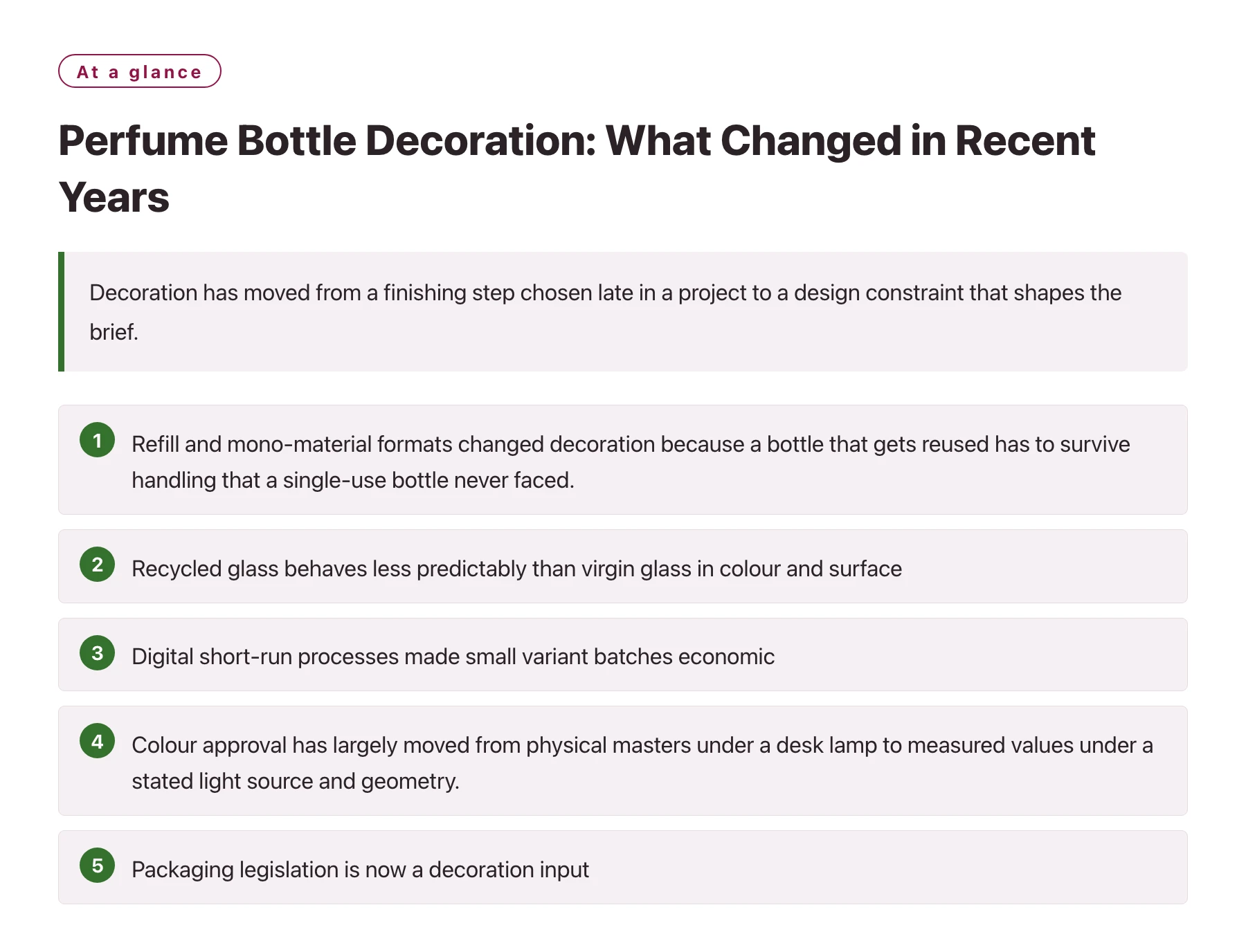
- Refill and mono-material formats changed decoration because a bottle that gets reused has to survive handling that a single-use bottle never faced.
- Recycled glass behaves less predictably than virgin glass in colour and surface, so decoration has to be specified with a wider material variation in mind.
- Digital short-run processes made small variant batches economic, which shifted demand from one big artwork to several seasonal ones.
- Colour approval has largely moved from physical masters under a desk lamp to measured values under a stated light source and geometry.
- Packaging legislation is now a decoration input, not an afterthought, because coatings and foils affect whether a component can be recovered.
Anyone who has run fragrance packaging for a decade will tell you the same thing: the bottles did not change as much as the specification process did. The material list is recognisable. What changed is how early the decoration decision is made, how precisely it is defined, and how many parties have an opinion about it.
This is not a trend list for its own sake. Each shift below changes something a buyer has to put in writing, and each one has a cost consequence that shows up at volume rather than at sample stage.
Where a change is driven by regulation or by market research, the source is cited so the claim can be checked.
Refill formats changed the durability requirement
A refillable fragrance bottle is handled far more than a single-use one. It is opened, refilled, wiped and put back on a shelf repeatedly over months or years, and every one of those cycles is an abrasion event for the decoration.
That changes the test protocol. Adhesion after rubbing, resistance to alcohol-based products and resistance to repeated handling matter more than they did when a bottle was opened once and thrown away. It also pushes decoration toward methods that can be protected with a compatible top coat, and away from treatments that sit unprotected on a high-contact surface.
Refill and refill-adjacent formats are no longer a niche positioning choice; consumer research publishers such as Mintel report on them as a regular part of the category [4]. For a decoration buyer, the operational consequence is simpler than the marketing story: more handling cycles have to be designed and tested for.
Mono-material design and the decoration trade-off
Designing a pack so that components separate easily at end of life has become a mainstream objective, and decoration is part of that calculation because coatings, foils and adhesives can complicate recovery [1]. The trade-off is real: the most striking finishes are often the hardest to recover, and the buyer has to decide which objective wins for which market.
Regulation as a decoration input
European packaging rules have been moving toward design-for-recycling and recycled-content requirements, which means decoration and pack construction are assessed together rather than separately [2]. Designers who treat this as a constraint from the start avoid the expensive version of the exercise, which is redesigning a launched pack.
Short runs and the rise of the variant
Digital decoration and digitally produced labels lowered the point at which a small batch becomes economic. That did not eliminate tooling, but it did make the second artwork of a range far easier to justify than it used to be.
The result is a different demand pattern: brands want more variants, released more often, in smaller quantities each. That is workable, but it changes the cost structure, because changeover rather than material becomes the dominant fixed cost.
What this means for a large programme
A large programme now usually contains several variants rather than one. The buyer's job is to group them so that changeovers are few, and to standardise the shared components so only the decorated element changes. Niche and independent brands drove much of this demand for variety, and the supply chain adapted around them [3]. The relevant reading for a volume buyer is not the trend itself but the scheduling consequence: fewer, larger batches of each variant, sequenced to minimise line stops.
Recycled glass and colour variation
Recycled glass is now a normal part of the mix, and it does not behave identically to virgin glass. Colour cast and surface condition vary more between batches, which makes the decoration more sensitive to substrate differences. The fix is procedural rather than technical: approve decoration samples on the actual glass being used for the run, and state a tolerance for shade variation instead of assuming zero.
Then and now, in specification terms
| Aspect | The older working assumption | The current working assumption |
|---|---|---|
| When decoration is chosen | After the bottle is sourced | During bottle and pack design |
| Colour approval | Physical master and a visual check | Measured value, stated light source, signed sample |
| Artwork variants | One design per range | Several variants, grouped to limit changeovers |
| Durability testing | Survives normal use | Survives repeated handling if the pack is refillable |
| End of life | Not a decoration question | An input into method and material choice |
| Supplier scope | Decorator separate from filler | Decoration and filling planned as one sequence |
The bottom row is the one with the largest commercial effect. When decoration and filling are planned together, the handling sequence and the reject responsibility are defined once, instead of being argued about after the first shipment.
The parts that did not change
Three things are as true now as they were before any of these shifts. A physical approved sample still beats any render. Registration tolerance still decides whether an artwork is manufacturable. And a factory that can describe its own process in numbers is still easier to work with than one that describes its output in adjectives.
Brands that plan launches around variety rather than around a single hero product should think about the whole sequence rather than the decoration step alone, because the sequence is where the savings are. It is also why the market has moved toward combined scopes: a supplier that covers decoration and production can commit to the rise of niche perfume brands style launch calendars, with smaller batches and more frequent releases, without the buyer having to coordinate a separate decorating vendor.
For buyers sourcing across borders, the same logic interacts with local expectations about finish and price. What reads as premium in one market can read as heavy in another, and export-facing manufacturers tend to accumulate that knowledge as a by-product of shipping widely, which is part of what makes what the global market wants from Chinese perfume a genuine planning input rather than a slogan.
The decoration specification is now a document that outlives the launch. Keeping it versioned, with dated samples and measured colour values, is the cheapest insurance in the whole project.
It is also worth reading how a manufacturer describes its own scope before shortlisting, because the detail published on a page such as Xuelei's official website indicates whether design, filling and packing are genuinely one sequence or three separate vendor relationships.
If you are rewriting a decoration specification from scratch, add two fields that older templates often lack: the light source used for colour approval, and the light source used for inspection on the line. Disagreements about colour are very often disagreements about lighting, and writing both down removes the argument before it starts.
Sources
- Sustainable Packaging Coalition —— A membership organisation working on more sustainable packaging design, publishing material and recyclability guidance.
- European Commission: Packaging Waste and the PPWR —— EU rules on packaging and packaging waste, including the Packaging and Packaging Waste Regulation requirements on recyclability and design.
- Cosmetics Business —— A trade publication covering the beauty and cosmetics industry, including fragrance launches and regulatory developments.
- Mintel Press Centre —— Mintel's press releases on consumer and beauty market research, including fragrance and personal care trend reporting.
Frequently asked questions
Are refillable bottles harder to decorate?
The decoration is not necessarily harder to apply, but it has to survive more handling. Adhesion after abrasion and resistance to cleaning and alcohol-based products become primary acceptance criteria rather than secondary ones.
Does recycled glass change the colour of a decoration?
It can, because recycled glass varies more in colour cast and surface condition than virgin glass. Approve decoration on the glass actually being run, and agree a shade tolerance instead of expecting an exact match to a sample made on different glass.
Has digital printing replaced screen printing?
Not for high-volume production of a single design, where screen printing remains efficient and durable. Digital processes have made short runs and frequent variants more affordable, which is a different job from decorating a large single-artwork run.
How is colour approval usually done now?
With a measured value, a stated light source and a signed physical sample held by both parties. Visual approval alone is still common, but it tends to produce disputes when components meet on the assembly line.
What is the biggest decoration-related cost change in recent years?
The shift from one artwork per range to several variants per range. Material cost has not moved dramatically; changeover cost has become the line item that decides whether a launch calendar is affordable.