Economical Formwork Panels for Short-Cycle Concrete Projects
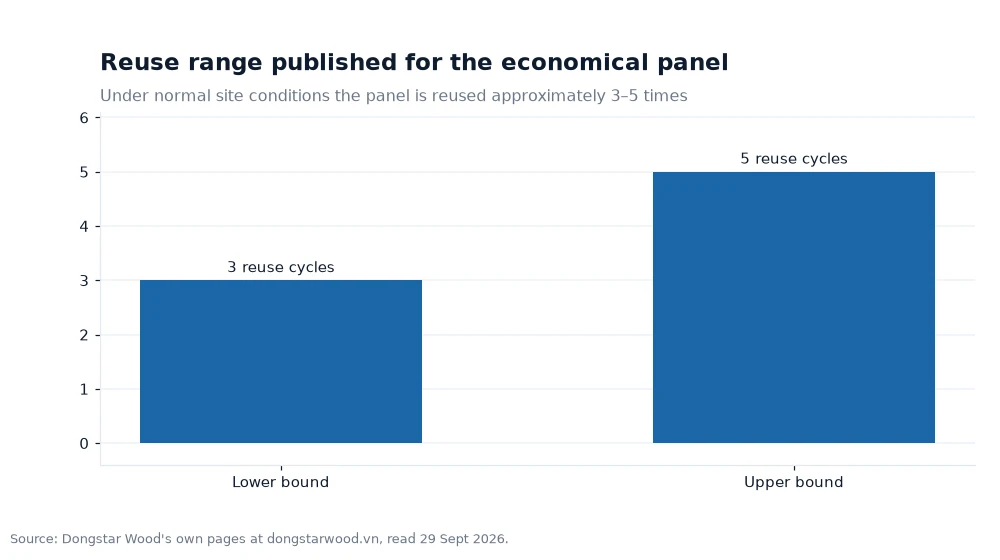
Not every pour deserves premium formwork. For footings, kerbs, small slabs and one-off house plots, a panel that delivers three to five clean strikes at a low cost per square metre beats a heavy panel that is still serviceable when the job is finished. The manufacturer's economical option uses Vietnamese plantation acacia veneers and a melamine bond tested to what its own page calls a 10 Hours Boiling Test.
Key takeaways
- Published reuse for this panel is approximately 3–5 times under normal site conditions.
- The bond is melamine, described with a boiling test of about 10 hours at panel level.
- The most requested European format is 1250 × 2500 mm, with 21 mm as the best-selling thickness and 18 mm next.
- Core veneers come from Vietnamese plantation forests, with drying, assembly and pressing carried out in one factory.
When the economical panel is the rational choice
Premium formwork earns its price on repetition: the same panel cycling through a tower, a tunnel or a long run of wall pours. Short-cycle work is different. Foundations, kerb lines, retaining walls on a single plot and small industrial slabs are poured once or twice, stripped, and forgotten. Buying a panel engineered for twenty strikes and using it for three leaves most of the value in the yard.
The economical panel is positioned exactly there — a lower cost per project, an acacia core, and a face that still produces a smooth concrete finish. It is supplied to distributors, builders and formwork companies that price work per project rather than per formwork asset.
The bond behind the panel
What separates a short-cycle panel from a disposable one is the adhesive, not the film. The published bonding here is melamine, carrying what the product page describes as an approximate 10 Hours Boiling Test — a bond that survives hot water exposure rather than delaminating the first time it rains on a stripped board.
That matters in practice on two fronts. A bonded panel can be stacked outside between pours without its edges opening, and it can be cleaned with a hose instead of being scraped with a trowel. Neither job is glamorous, and both are what actually shorten a panel's life.
Sizes and thicknesses European buyers request
| Item | Published detail | Effect on site |
|---|---|---|
| Requested format | 1250 × 2500 mm | Fewer joints on standard foundation work |
| Best-selling thickness | 21 mm | Stiffer spans between bearers |
| Second thickness | 18 mm | Lighter panels for hand work |
| Core | Acacia veneers from Vietnam plantation forests | Stable core under short-term loading |
| Bond | Melamine, tested to about 10 hours boiling | Survives rain and hosing between pours |
Orders that mix thicknesses are common, and they should be. Crews reach for 18 mm where a panel is being lifted by hand all day and switch to 21 mm where the panel spans between wall plates or joists.
Worked example: contact area and sheet count per pour
Start with the format European buyers ask for: 1250 × 2500 mm, which works out at 3.125 m² of face from each 1.25 m × 2.5 m panel. At three strikes the contact area is 3 × 3.125 = 9.375 m², and at the upper end of the published range it reaches 5 × 3.125 = 15.625 m² per sheet.
Apply that to a job. A scheme needing 500 m² of concrete contact surface takes 500 ÷ 15.625 = 32 sheets if every panel delivers five strikes, and 500 ÷ 9.375 = 53.3, so 54 sheets, if each delivers only three — example arithmetic on the published reuse range, and the honest way to price formwork for a short-cycle project.
How the panels are produced
The published process runs in four stages: moisture-controlled drying, multi-layer panel assembly, high-pressure hot pressing, and quality inspection before shipment. Drying is the stage that decides everything downstream; veneer that is pressed wet produces a panel that moves after it leaves the yard, whatever the bond class.
Batch inspection is described around two items — panel thickness consistency and core construction integrity. Both are checks a buyer can repeat on arrival with a tape and a visual scan of a cut edge, which makes them a useful benchmark for a first order.
Panel assembly is where flatness is won. Veneer sheets are laid in alternating grain directions and pressed as one stack under high pressure, which is what stops a board cupping after it has been stripped, stacked wet and re-used. A press that is too light for the stack produces a panel that looks correct on day one and bows after the second pour, so the process detail is worth asking about rather than assuming.
Where this panel is the wrong answer
Anyone planning a shuttering programme with a hundred repeats on the same set of panels should not buy on cost per sheet. The published reuse figures for the economical panel are a fraction of what high-grade stock achieves, so the per-strike cost falls if you buy a heavier panel with a higher-grade film and a stronger bond.
The same logic applies to fair-faced concrete that will be left exposed. Film quality and surface smoothness drive the finish, and an economical board that has already been used twice will telegraph its history into the concrete. Use it for the pours that will be covered or rendered; spend the money where the surface stays visible.
Ordering and storage notes that protect the value
Three habits stretch the published reuse range. Lift panels rather than dragging them across the deck, because dragging scuffs the film faster than any pour does. Seal cut edges on site with a repair paint so the acacia core does not take water through the end grain. And clean the face with a scraper rather than a hammer when concrete residue sets.
Ask the supplier to confirm the thickness and the bond class on the quotation, then check the same two values on the delivery note. A Black Film Faced Plywood quote that names only a size leaves the buyer guessing on both.
Frequently asked questions
How many times can the economical panel be reused?
Published guidance is approximately 3–5 times under normal site conditions. The outcome depends on the pour, how the panels are handled and whether cut edges are sealed; a set that is cleaned carefully and stacked flat will sit at the top of that range.
Is a melamine bond good enough for outdoor formwork?
It covers normal site weather. The bond is described with a boiling test of about 10 hours, which is what allows panels to be hosed and stacked between pours without the plies opening, but nobody should leave them under standing water or expect the performance of a heavier phenolic system.
Which thickness should a first order be based on?
Ask for the formats your crew already uses and compare both of the thicknesses buyers request most, 21 mm and 18 mm. The heavier panel spans further between bearers; the lighter one is easier to handle all day. A mixed order is the usual compromise.
Where to compare before ordering
Set the reuse expectation against the pour list first, then choose the panel to match. The specification for the economical panel range gives the format, thickness and bond detail in one view, and comparing it with the wider film faced range shows what a higher-grade film and bond add when the same set of panels has to run many more times. Where the pour is served by a route crews will walk on, the textured anti-slip panel is the safer board underfoot, and it can share the same bearer layout as the formwork set.
Published specifications and figures quoted in this article were read from the maker's own pages, as consulted on 29 Sept 2026 and used throughout the table above and used throughout the table above as the source for this article[1].